Old Nero
The Boys in the BoatOld Nero was the University of Washington’s training barge and the first proving ground for generations of novice rowers. In 1933, its broad, flat-bottomed hull gave freshmen a place to learn the racing stroke before they were trusted with delicate shells, while turning errors in timing and technique into public, physical consequences.
Design and Long Service
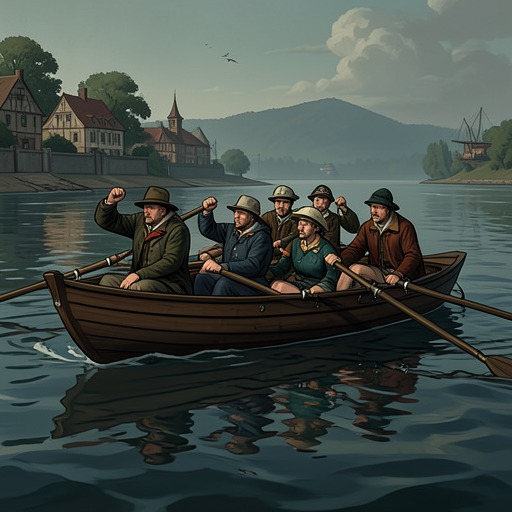
Old Nero was a wide, flat-bottomed scow with a long walkway down its center and seats for sixteen novice oarsmen. The arrangement let the coaches move among the students as they rowed, observing and correcting them at close range. Since 1907, the barge had served as an initial test for Washington freshmen—virtually the whole of the university’s thirty-year crew history by the time the 1933 class took its first turns aboard.
The vessel stood between instruction and competition. The freshmen were not ready for the delicate confines of a racing shell, so they waited their turns to board Old Nero after Tom Bolles finished talking and George Pocock returned to his shop. They carried the long, white-bladed oars down to the water and began on the larger, more forgiving craft instead of risking expensive racing equipment.
The Freshmen’s First Lessons
In the first few days of 1933, Tom Bolles and Al Ulbrickson walked Old Nero’s central passage in gray flannel suits and fedoras. Ulbrickson watched quietly, sizing up the boys; Bolles called out a near-continuous stream of corrections. He instructed them on grip, blade angle, posture, knees, and when to pull harder or ease up. The work was bewildering and exhausting. Despite the freshmen’s effort, they moved the barge slowly and erratically out of the Cut and onto Lake Washington as they tried to absorb the lessons and synchronize their strokes.
The barge was also a means of selection. Al Ulbrickson called boys unsuited to crew “mollycoddles,” and Old Nero was designed in part to make such novices recognize early that the sport was not for them—before they could break costly oars or racing shells. Its rough training exposed the distance between exertion and effective rowing: a boat could be full of straining students and still make little, uneven progress if their efforts did not work together.
The Cost of a Mistimed Stroke
A particular error taught itself without a coach’s reprimand. If a blade entered the water too deeply, at the wrong angle, or out of time with the others—or stayed submerged a fraction too long at the end of a stroke—the rower might “catch a crab.” The oar would stick fast in the water, while Old Nero kept moving. The mismatch between the barge’s forward motion and the trapped blade could smack its holder in the chest and knock him off his seat; if he clung to the oar, he could be pitched into the water.
That hazard made every stroke a possible scene of cold, conspicuous humiliation. Old Nero therefore taught more than isolated mechanics: its movement made each rower’s timing consequential to the others, and its broad training platform exposed the bodily cost when a novice failed to coordinate with the boat. Before the freshmen could enter racing shells, they had to learn that effort alone could not keep an oar—or a crew—in motion.